Pretty much every motorhome worthy of the title has a water pump on board these days.
In general, they are pretty reliable pieces of kit but, as with everything mechanical, sometimes they fail, which is why we always recommend checking the pump is working when you’re preparing your motorhome for touring.
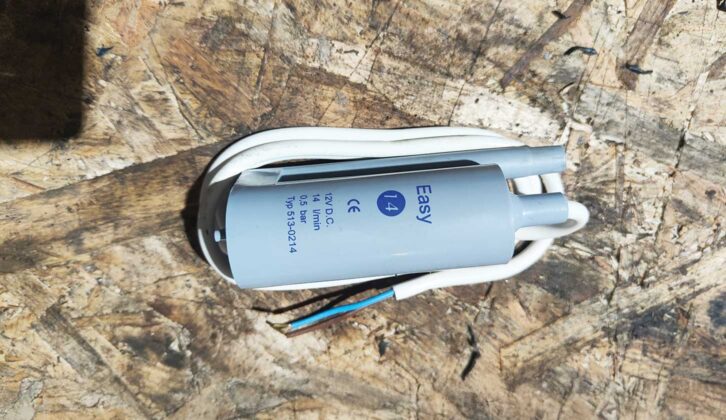
There are three main types of water pump: the diaphragm pump, which sits in line between water tank and taps; submersible centrifugal ones, which live in the water tank itself; and in-line centrifugal, which are similar in function to the submersible type but are mounted outwith the tank and in line between the tank and taps.
Of the three types, the centrifugal in line are almost never seen these days – in fact I can’t recall the last time I saw one in a motorhome. Diaphragm pumps are by far the most common in British-built motorhomes, and, in my opinion, are sometimes a bit more reliable than submersible types. The submersible units are often fitted in German-built motorhomes, although there are a couple of UK converters still using them.
The first thing to know about a water pump is that it doesn’t create water pressure, it makes water flow – the pressure is generated by pushing a volume of water through an aperture. The smaller the aperture and/or higher the flow rate, the greater the pressure in the water system.
With a diaphragm pump, when you close the taps the flow builds pressure until the cutoff setting is reached, then the pump shuts off – I’m sure many have noticed that, when first opening a tap, there is a rapid burst of flow which slows slightly after a few seconds.
Also if you only open a tap part-way you have effectively reduced the aperture, so the pressure will increase, pump cuts out, flow continues and pressure drops, pump cuts in again. This will also happen if all taps are closed but there is a leak somewhere in the system.
Submersible pumps can create very strong flow depending on the model in question; Reich’s Twin unit, for example, can move up to 19 litres per minute.
One big difference between centrifugal and diaphragm pumps is that the diaphragm type naturally resists reverse flow, while the centrifugal types need a non-return valve to prevent boilers from draining back to the tank.
The best designers make sure that whichever pump type is used, it is accessible. German converters often fit the water tank in a seat locker with an access hatch on top, for example, while many diaphragm pumps are fitted close to the tank or even on top of it. However, there are a few that hide them away in cupboards where they are almost completely hidden.
I’ve also seen tank pumps used where the tank is mounted under the floor, so you have to drop the tank to get to the pump, making it a labour-intensive job and therefore adding to the cost.
Take a look at what Motorhome Matt has to say about the different types of leisure battery, too, as he talks you through lead-acid, AGM and lithium options to help you find the right type for your ‘van.
Don’t miss my tips on how to clean the waste water tank in a motorhome, either – it’s a fairly straightforward job which can help you get rid of any unpleasant smells.
If you’ve enjoyed reading this article, why not get the latest news, reviews and features delivered direct to your door or inbox every month. Take advantage of our brilliant Practical Motorhome magazine SUBSCRIBERS’ OFFER and SIGN UP TO OUR NEWSLETTER for regular weekly updates on all things motorhome related.