The best portable power station for a campervan can make a real difference to any camping experience, acting as a stand-alone power source and allowing you to keep your various gadgets topped up.
Generally coming with their own inverter, portable power stations are available in a variety of sizes, with larger models providing longer run times and offering more outlets than their smaller – but more budget-friendly – counterparts. However, these bigger options are typically heavier, so they will need to be moved around carefully. Owners will also have to factor this weight into their ‘van’s payload when planning the tour-enhancing gadgets, such as the best campervan projector or a camping grill, to take with them.
The vast majority of portable power stations come with a built-in inverter which links to a 240V socket (if not more than one), as well as USB-A, USB-C and 12V sockets, so you can stay powered up when you’re pitched up at a campsite or are enjoying some off-grid campervanning.
However, packing a portable power station for a campervan doesn’t mean you can suddenly take your own 3000W electric kettle from your home kitchen on tour with you. You’ll generally be using electrical items which run on less than 500W. If you’re planning to power more delicate items, such as a coffee machine, laptop or similar, you’ll need one with a pure sine wave inverter, which smooths the electrical current, and also works with the majority of 240V equipment.
This contrasts with a modified sine wave inverter, which is completely different but cheaper. Choose the right one, though, and you’ll be set for powering tour-enhancing accessories such as the best air fryer for a motorhome.
To help you find the right one for you, we’re running through our favourite options for the best portable power station for a campervan, including models with a variety of capacities and from brands such as Bluetti, Jackery and Ecoflow.
Practical Motorhome is supported by its audience. When you purchase through links on our site, we may earn an affiliate commission. Learn more
The best portable power station for campervans
Bluetti EB3A – check the latest price on Amazon now
Jackery Explorer 1000 V2 – check the latest price on Amazon now
Anker 521 – check the latest price on Amazon now
EcoFlow Delta 3 Max – check the latest price on Amazon now
Anker SOLIX C1000 Gen 2 – check the latest price on Amazon now
Bluetti AC200L – check the latest price on Amazon now
Ecoflow Delta 2 – check the latest price on Amazon now
The best portable power station:
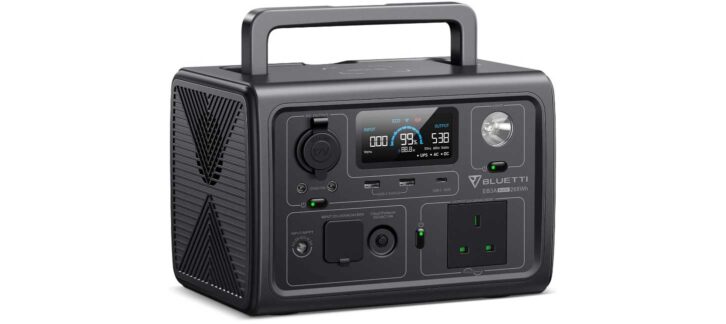
Bluetti EB3A
- Battery capacity: 268.8Wh (12Ah)
- Dimensions: 255 x 180 x 183mm
- Weight: 4.6kg
- Outlets: 1 x 12V socket, 2 x 12V DCs, 2 x USB-As, 1 x USB-C, 1 x 220-240V AC/600W port
Reason to buy:
- Budget-friendly, fairly lightweight, wireless charging pad provided
Reason to avoid:
- Motorhome owners could want better battery capacity
We were instantly impressed by the weight of the EB3A when we tested it. At only 4.6kg, it’s among the lighter options in our guide, ideal if you’re looking for a more manoeuvrable portable power station or simply want to avoid denting your payload too much.
One of our favourite features is the 15W wireless charging pad, very handy for giving your phone a top-up when needed. Charging is fairly simple too, just requiring plugging into the mains with its AC charging cable – we found it took around 1.5 hours to fully charge this way. Other options include charging via a 12V port, via a solar panel or with a generator, but you’d need separate accessories for this.
Thanks to its 600w AC pure sine wave inverter (1200W surge) and 268Wh capacity, it could power numerous items such as mini rice cookers, but we were especially keen to look at its ability to simultaneously charge several smaller devices. It proved more than up to the challenge, with four iPhones and a laptop staying topped up when our tester Paul went off-grid for a couple of days. Usefully, it also comes with a LiFePO4 battery, so it should be rechargeable over 3,000 times.
Full review: Bluetti EB3A

Jackery Explorer 1000 V2
- Battery capacity: 1070Wh
- Dimensions: 32.7 × 22.4 × 24.7cm
- Weight: 10.8kg
- Outlets: 2 x USB-C, 1 x USB-A, 1 x DC Car, 2 x Pure Sine Wave AC
Reason to buy:
- Updated version of a tried and trusted model, offering faster charging and more power
Reason to avoid:
- At 10.8kg, it’s fairly heavy
We previously tested the original Jackery Explorer 1000 and found it an effective and straightforward power station to use. It has since been updated, and, according to Jackery, the revised model provides 50% more power and also charges significantly quicker; in fact, it will be 7.5x faster if you opt to use the app-controlled 1-hour charging.
The Explorer 1000 V2 has an output of 1500W and a surge peak of 3000W. Thanks to its LiFePO4 battery, we like how it should offer an excellent lifespan, supporting up to 4,000 life cycles and keeping a capacity of more than 70%.
The selection of ports will always be important when choosing the best portable power station, and here, we think you get a good range: two USB-C ports, a USB-A port, a DC Car Port, and two Pure Sine Wave AC Ports, with one of the USB-Cs providing 100W PD Fast charging.
With these, you will find it’s capable of recharging a phone up to 74 times, a laptop up to 14 times, and operating a coffee maker for up to 94 minutes.
We like how the CE-certified portable power station provides a range of safety features too, giving you peace of mind when touring. Should you deide you’d prefer a smaller size too, you could opt for the Jackery Explorer 500 V2, which has a capacity of 512Wh.
We will highlight its weight – at 10.8kg, it’s not the most lightweight portable power station on the market, something to look out for if you’re particularly lacking in payload in your campervan or motorhome. However, we appreciate that it comes with a handle, which should help to make it easier to manoeuvre – unlike the previous version, this can also be folded in when it’s not in use.
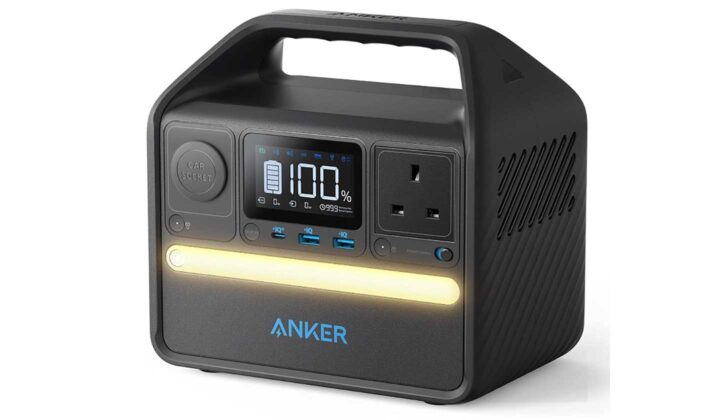
Anker 521
- Battery capacity: 256Wh
- Weight: 3.7kg
- Dimensions: 216 x 144 x 212 (in mm)
- Outputs: 1 x car outlet, 1 x USB-C, 2 x USB-A, 1 x AC
Reason to buy:
- Compact, lighter than Bluetti, clear display
Reason to avoid:
- Limited amount of outlets, slower recharge time than other portable power stations
We’d say the Anker 521 is an ideal option for anyone who wants an entry-level gadget to power their other touring accessories that run at under 200W. It’s worth noting just how lightweight it actually is – at only 3.7kg, it’s the lightest model in our guide, nearly a whole kg lighter than its nearest rival, the Bluetti EB3A. It does come with fewer ports, but if weight is an important factor to you, that could be a price worth paying.
That’s not to say you don’t get a good selection though – with two USB-A ports, a USB-C port and both an AC port and a car outlet, you still get some good options for keeping your products charged up when you’re touring in your campervan. It takes around two and a half hours to charge, which is longer than the Bluetti (which takes one and a half hours), and significantly slower than the Ecoflow River 2 Max (which takes only an hour).
A feature we do really like with the Anker is the clear display it comes with, allowing you to keep track of its battery level. Also, if you need it, the portable power station, which has a LiFePO4 battery, usefully includes an inbuilt light.
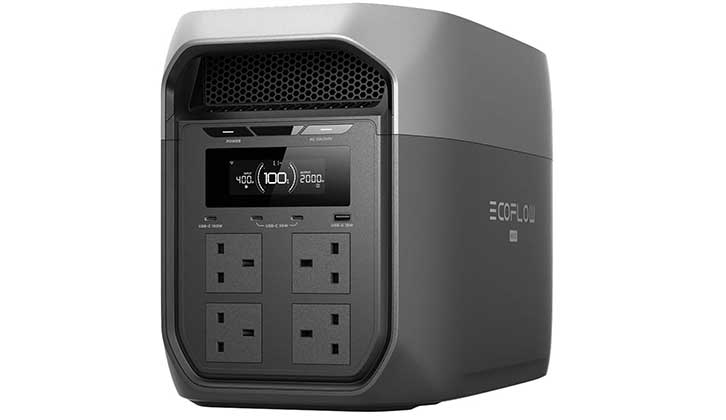
EcoFlow Delta 3 Max
- Battery capacity: 2048Wh
- Weight: 20.3kg
- Dimensions: 49.4 × 23.9 × 30.5cm
- Outputs: 4 x AC (24ooW total, Surge 4800W), 1 x USB-A (18W Max), 3 x USB-C (2 x 30W Max (Total 30W, 1 x 100W Max (HID)), 1 x 12V DC output
Reason to buy:
- Powerful yet more lightweight and compact than equivalent products
Reason to avoid:
- It’s still quite heavy to move around, capacity can’t be expanded
The Delta 3 Max lives up to its name, providing plenty of power at a more convenient weight, as well as a good selection of ports, which includes three USB-C ports and four USB-A ports.
One of our favourite features is its weight of 20.3kg, which we think is a bit more manageable than that seen in other portable power stations with equivalent capacities on the market.
Thanks to its X-Stream technology, it’s quick to charge, capable of going from 0% to 80% in only 51 minutes. We also like how there is a good selection of charging options, including via a mains AC outlet, through a solar panel, and with an alternator charger. A LifePO4 battery should give you peace of mind that it’s built to last as well, with the power bank built for use for 10 years of daily use.
We like how it will let you use your favourite touring gadgets when you’re pitched up. In fact, EcoFlow has said it could keep one of the best campervan projectors charged for up to 26.94 hours, or a laptop for 29.18 hours. Or if you want to improve the cooking options in your campervan, it could keep a 1,150kg electric grill going for 1.52 hours.
There’s also its impressive X-Boost output of 3200W, which gives you the freedom to use more powerful appliances when on tour.
Something we will point out is that it doesn’t have the option of expanding its capacity, which other models, such as the Bluetti AC200L or the Delta 3 Max Plus, offer.
However, if that’s something you’re not looking for in your power station, this EcoFlow has a lot going for it, most notably its lightweight.
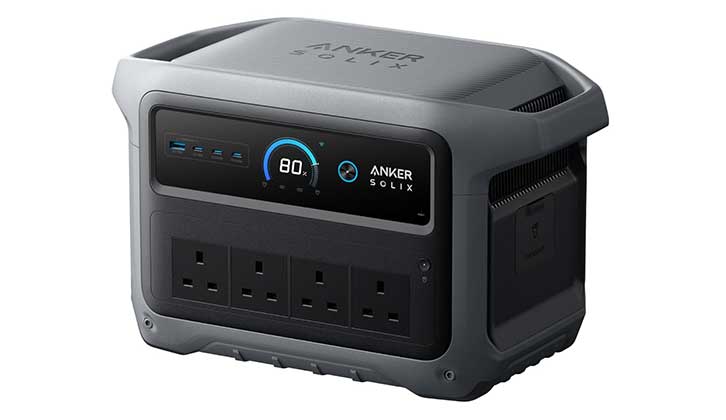
Anker SOLIX C1000 Gen 2
- Battery capacity: 1024Wh
- Weight: 11.3kg
- Dimensions: 38.4 x 20.8 x 24.4cm
- Outputs: 4 X AC (2000W), 1 x 12W USB-A, 2 x 140W USB-C, 1 x 15W USB-C, 1 x 120W car port
Reason to buy:
- Capable of fully recharging in only 49 minutes, second generation model made lighter and more compact
Reason to avoid:
- Capacity cannot be expanded
The second generation of the Solix C1000 is a good mid-level portable power station from Anker. We like how it manages to combine a fairly decent weight of 11.3kg with a good selection of nine ports, including three USB-C ports and four AC outputs.
There are an impressive six ways to top the battery up, too, including taking only 49 minutes to fully charge via a 1600W AC outlet, or 1.8 hours via a 600W solar panel.
You could use it to charge a phone up to 50 times, run an electric grill for up to 0.9 hours or use a microwave for 0.6 hours.
Something we like about the SOLIX C1000 is how Anker has managed to make the second generation of this model 11% lighter and 14% smaller, which will help you save on both your payload and the amount of storage you need to allocate to it. However, something worth noting is that this does come at the expense of being able to expand its capacity.
However, you still get a good lifespan, which is always going to be a crucial trait in the best portable power station. The Anker has been built for a decade of use, and should still have a battery with a capacity of at least 80% after 4,000 cycles.
Check the latest price on Amazon now.

Bluetti AC200L
- Capacity: 2048Wh
- Dimensions: 31.4 x 20.95 x 25.58cm
- Weight: 28.3kg
- Outputs: Four x 20A AC ports, two x USB-C ports, two x USB-A ports, one x 48V DC Port, one x car port
Reason to buy:
- Provides plenty of capacity and can be extended to up to 8,192Wh
Reason to avoid:
- Very heavy and more powerful than many will require
We’d recommend this Bluetti for motorhomers and campervanners who are prioritising a high capacity in their portable power station.
With an immense capacity of 2048Wh, this Bluetti is ideal for gadget-loving campervanners and motorhomers. We like how it comes with an impressive 10 ports, and its already high capacity can be further expanded to reach up to 8192Wh if you buy compatible battery packs.
Its 10 ports include four 20A ACs, two USB-Cs, two USB-As, one 48V DC, and a car port, while a LiFePO4 battery should give it a good 10-year lifespan.
There is an impressive selection of recharge options too; plug it into a suitable AC socket, and you can achieve a maximum 2400W of AC power to top the battery up from 0-80% in just 45 minutes. Alternatively, it can be charged via solar panels, through a combination of AC and solar, or via a car lighter port.
However, there is a downside to this impressive capacity – it has a weight to match. Coming in at 28.3kg, this Bluetti is the most payload-hungry portable power station in our guide, so you’d need to make sure you’re happy moving such a weight around.
It’s not going to be for everyone, but if you need an immense source of power on tour and have the weight allowance for it, this Bluetti could be the best portable power station for a campervan for you.
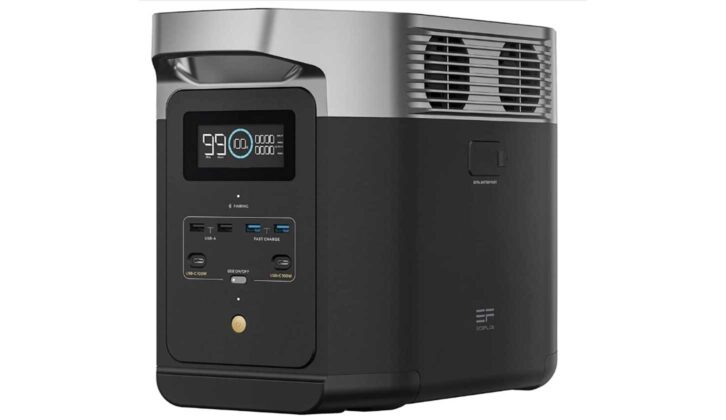
Ecoflow Delta 2
- Battery capacity: 1kWh
- Weight: 12kg
- Dimensions: 400 x 211 x 281 (in mm)
- Outputs: 2 x USB-A fast charge sockets, 2 x USB-A, 2 x USB-C, 4 x AC sockets , 2 x DC5521 Outputs
Reason to buy:
- Excellent capacity, capacity can be further increased with additional batteries
Reason to avoid:
- Requires additional batteries to maximise its potential, heavy
The EcoFlow Delta 2 may have a lower capacity than the Bluetti AC200L, but it still comes with an impressive 1kWh capacity as standard and also offers extra outputs. That’s not all – there’s the option of buying additional batteries to boost it to as much as 3kWh, ideal for families on the road who want plenty of power.
The inclusion of built-in handles will make its 12kg weight easier to move around. It also has an LFP battery, giving you a product you can charge over 3,000 times.
Its main selling point is its sheer versatility, as it’s capable of powering an impressive 13 devices at once. The manufacturer says it could charge a laptop 16 times, a phone 89 times and a mini-fridge for a minimum of 16 hours, offering plenty of power. It’s also impressively fast if it needs charging before setting off – it can be topped up from 0 to 80% within 50 minutes via the AC outlet.
There’s no getting away from its price, but if you want a powerful gadget with an excellent battery capacity, this could be the best portable power station for you.
How to choose the best portable power station
Choosing the best portable power station will give you the freedom to use more of your favourite gadgets when you’re pitched up on tour.
When you’re browsing the various options on the market, make sure you know (or at least have an idea) of what you want to power with it. This will not only set you up to work out the capacity you will need to be looking for, but will also ensure you have the right sockets. Are you after more USB-C and 12V sockets, for instance, or do you want a wireless charging pad?
Some of the best portable power stations can have additional battery units clipped on to provide even more power, which could come in particularly handy if you’re off-grid. Is this something you’d want to have the option of doing? If so, it’s something you will want to ensure any power bank you consider offers.
Know what type of inverter you want. If in doubt, our tech expert, Peter Rosenthal, advises opting for a pure sine wave inverter, as it can be used with a wider range of electrical gadgets, in contrast to the cheaper modified sine wave inverter.
Make sure you factor in the weight as well. While having more power can be tempting and give you the freedom to operate more gadgets on the go, this will come at the cost of a hefty weight. Make sure you have the payload allocation to take a gadget weighing at least 20kg on tour with you, and think about how you will find moving such a weight around. It would rather defeat the purpose of a portable power station if it’s too heavy for you to move, after all, whether you’re using it at home or indoors.
Put this altogether and you will be well on your way to choosing the best portable power station.
Are portable power stations worth it?
There’s no getting away from the price associated with a portable power station, as well as the payload it will subsequently eat up when you take it on tour. So, is it worth adding one to your touring setup?
This is because there are two main advantages to opting for one. Firstly, as its name heavily implies, it gives you a portable source of power, and secondly, it saves you from possibly damaging your motorhome with bodged wiring, as well as possibly stress about DIY.
They provide a useful way of accessing power when you’re pitched up and, should you be a fan of eco-friendly touring, can be paired with a solar panel for charging.
However, there is no getting away from their price. Of course, you could look to double your battery bank instead, or if you’re after an inverter, an extra 12V or USB sockets, get them fitted by a professional.
What you are paying for with a portable power station is essentially the convenience of getting sockets, a battery, and an inverter in this portable power bank without having to do anything more than charge it up to access the power.
In the words of our tech expert, Peter Rosenthal, a portable power station is worth considering if “you’re looking for a neat, portable, all-in-one pack that can recharge a variety of items no matter where you are – including at home”.
Future Publishing Limited, the publisher of Practical Motorhome, provides the information in this article in good faith and makes no representation as to its completeness or accuracy. Individuals carrying out the instructions do so at their own risk and must exercise their independent judgement in determining the appropriateness of the advice to their circumstances. Individuals should take appropriate safety precautions and be aware of the risk of electrocution when dealing with electrical products. To the fullest extent permitted by law, neither Future nor its employees or agents shall have any liability in connection with the use of this information. Double check any warranty is not affected before proceeding.
If you’ve enjoyed reading this article, why not get the latest news, reviews and features delivered direct to your door or inbox every month. Take advantage of our brilliant Practical Motorhome magazine SUBSCRIBERS’ OFFER and SIGN UP TO OUR NEWSLETTER for regular weekly updates on all things motorhome related.