It’s a fact that some of the most interesting toys can be found on the end of a towbar. From motorbikes to speedboats, canoes and racecars, adding a motorhome towbar to your ‘van can open up all manner of exciting hobby possibilities. Even if it’s only adding a couple of ebikes or some extra storage.
Any if you are thinking “but I don’t want to tow anything”, you’re missing the point – a tow hitch can carry all manner of interesting items and is best thought of as a universal attachment point. It’s the Swiss Army Knife of versatility and can be a motorhome upgrade well worth considering.
Most motorhomes are well suited to towing, being heavier than most cars and having a longer wheelbase. However, before you get too excited about fitting a towball hitch to your vehicle and towing a car with a motorhome or taking a motorbike on a motorhome tour, there are a few things to be aware of.
Understanding motorhome towbars
Check your licence
Adding a towing category to your driving licence
Fitting a towbar to a motorhome
What can your motorhome tow?
Bike racks on motorhomes
Types of trailer
Towing with A-frames
Improving the security
Worthwhile upgrades for tow vehicles
Speed limits and insurance for trailers
Check your licence
The first thing you need to do is check your driving licence to see what category codes you have (see what we have to say about motorhome weights if you need a refresh on the various terms you could come across here).
If you passed your test before 1 January 1997, you should be able to drive a motorhome and trailer combination of up to 8250kg maximum authorised mass (MAM). If you passed after 1 January 1997, motorhomes under 3500kg MAM can be driven on a B category licence, which is often referred to as a ‘car licence’, such as Mobilvetta Kea Kompakt 55 and the Coachman Sportivo 565.
There are plans in Europe to increase the B licence to include vehicles of up to 4250kg in weight (which is long overdue) and it’s highly likely that the UK will follow suit in this. Currently this only applies to electric vehicles (and hydrogen-powered vehicles).
This will greatly ease the pressure on UK makers who try to build vehicles as light as possible, to allow them to be driven on a B category licence, in an effort to make their vehicles appeal to as wide a market as possible (and see what we had to say about “what driving licence do I need to drive a motorhome?” if you want a refresh on the current rules).
The towing category with a B licence is detailed as BE (which should now be issued on new driving licences automatically). If you passed your test before 19 January 2013 you can tow any size of trailer so long as it remains within the towing limits of the vehicle.
If you passed after 19 January 2013 the MAM of the trailer is limited to 3500kg and must also remain within the towing capacity of the vehicle. Unless you plan on towing a couple of Range Rovers on a jumbo trailer, these limits should be fine for most cars and boats for the vast majority of people.
If your motorhome is heavier than 3500kg MAM but under 7500kg, such as the Coachman Avventura 565 or the Crozier Campers Beyond4, you’ll need to have category C1 on your driving licence. This allows you to drive with a trailer of up to 750kg in weight. Most people who passed prior to 1997 will also have C1E on their licence which allows them to tow trailers up to a combined maximum mass of 12,000kg. So if you have a 4500kg motorhome, you could in theory carry up to 7500kg on a trailer.
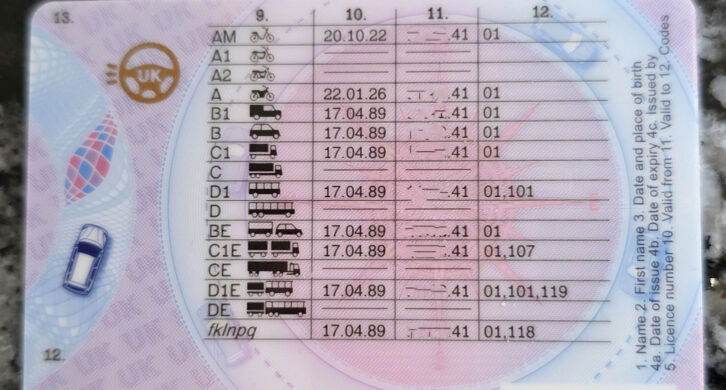
In practice, the motorhome makers limit the maximum weight you can tow (it’s usually between 2000kg and 3500kg for most vehicles). You also need to check your restriction codes on the licence – on the example shown (below left) the 107 code means the maximum combined weight of the trailer and tow vehicle can’t exceed 8250kg.
Adding a towing category to your driving licence
If you don’t have C1E on your licence, it can be added but you will need to do some training and spend a little money to achieve it. It typically costs around £1250 and usually comprises two days of training followed by a practical test.
The only alternative to this is to sell your C1 category motorhome and buy one under 3500kg MAM that can be driven with a trailer on the BE code on your driving licence.
Fitting a towbar to a motorhome
If your motorhome lacks a towbar, one can easily be added by a specialist motorhome firm. If your motorhome was first registered after 1 April 2012, you must have a Type Approved towbar fitted, compliant with EC94/20. Prior to that the towbar type isn’t specified.
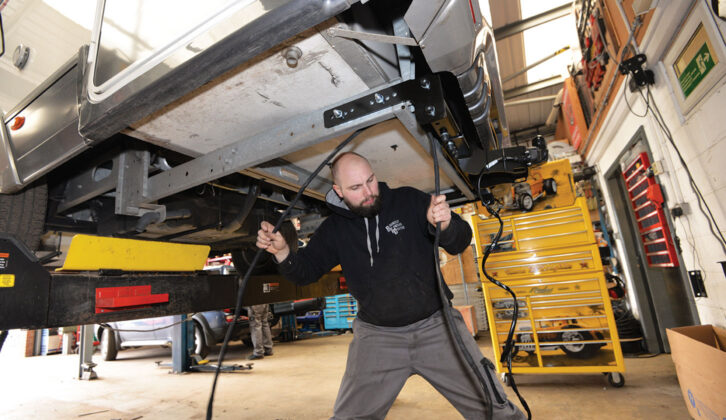
All towbars need to be fitted to a substantial part of the vehicle structure, which usually isn’t a problem on a van-based conversion. On some coachbuilt motorhomes with a long rear overhang a weighty extra section of chassis will need to be fitted to reinforce the structure, and the weight of this can have a significant effect on the payload due to the additional cantilever effect. Most, but not all, motorhomes can have towbars fitted, but always check first.
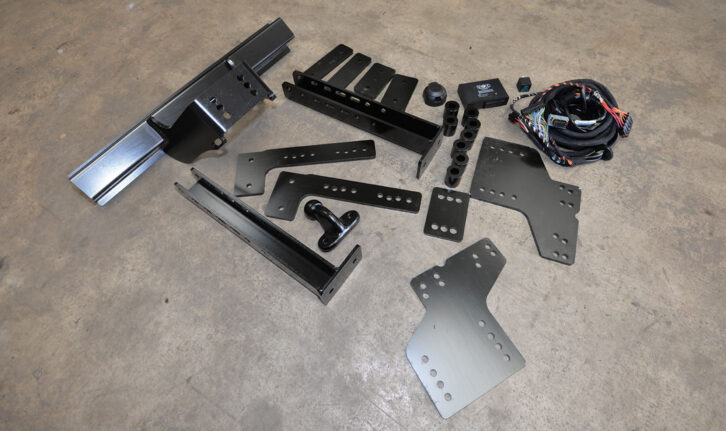
We’d recommend having motorhome towbars fitted professionally – they’re big heavy lumps of metal – and it’s wise to have the dedicated vehicle-specific wiring loom fitted at the same time. Generic wiring looms may not fully integrate with a modern vehicle’s stability control systems and can be a false economy. A good motorhome specialist towbar installer can advise you of these issues.
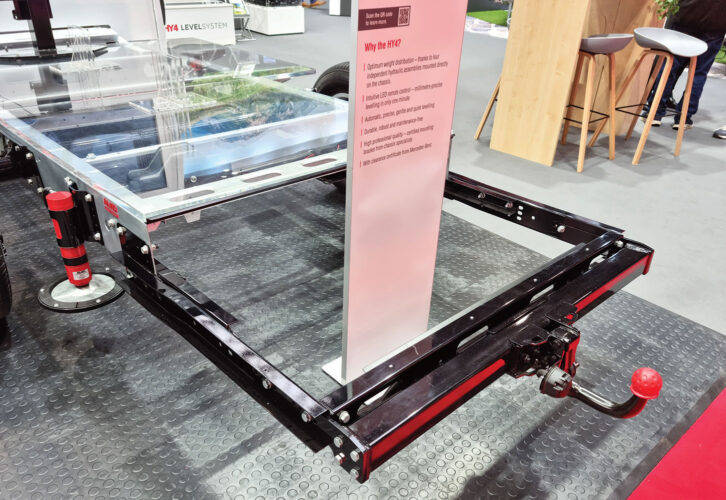
A van-based motorhome towbar fitment with basic electrics can cost a few hundred pounds, but a custom chassis extension with a dedicated wiring loom may cost a few thousand.
What can your motorhome tow?
Many people still hold the belief that a motorhome can tow any trailer of up to 85% of the weight of the motorhome. So up to 2975kg for a typical 3500kg.
However, in practice it doesn’t work like this and the motorhome manufacturer (or the base van maker in the case of a vehicle registered as ‘Van with Windows’ on the logbook) will stipulate the maximum towing limits based on factors such as rear overhang, the maximum torque load of the gearbox and the overall weight for a given spec.
Generally speaking, most motorhomes can tow somewhere around 2000kg, but don’t assume this – make sure you check it on your vehicle V5C logbook, owner’s handbook or the vehicle’s chassis plate.
Bike racks on motorhomes
Bicycle racks are probably the most commonly found item on the end of a towball, and motorhomes are very useful in this regard because they often have a noseweight limit.
The maximum noseweight is usually found on the towbar itself, or with the instructions supplied by the towbar manufacturer, and is the maximum vertical load that pushes vertically downwards on the towbar.
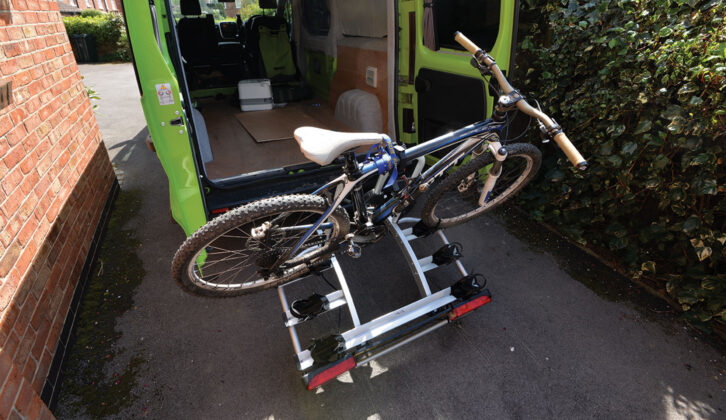
With motorhomes, the noseweight maximum is often around 100-150kg and this gives a useful amount of loading weight to carry. Remember that this maximum weight includes every item that is supported on the towball including the bike rack, the bikes, the securing straps, the cover, the security items and the reflective panel (which is needed if you plan on travelling to certain EU countries).
If you don’t want to use a bike rack on the towbar – often because you also need to tow a trailer – it’s usually not an issue, because most van- or coachbuilt-based vehicles can be fitted with a bike rack fixed to the bodywork.
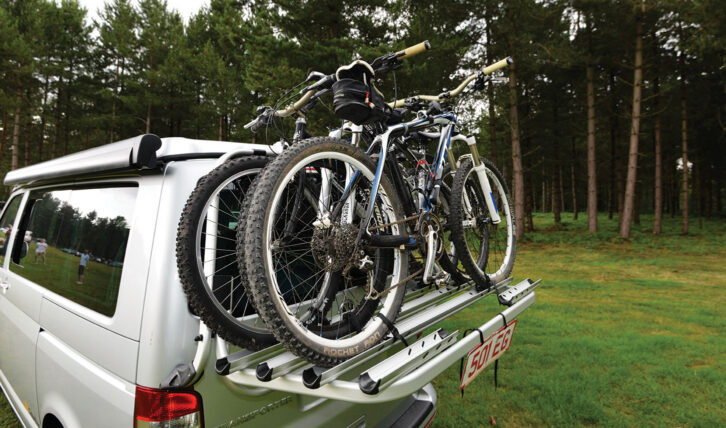
The only note of caution we’d add is to be very careful of the positioning of the rack with a Fiat Ducato panel van conversion – it’s not uncommon for the racks to hit the tail-lights and break them if you open the rear barn doors with too much enthusiasm!
Equally, with any bike rack fitted to the motorhome, make sure it doesn’t interfere with any part of the trailer when it’s on full lock.
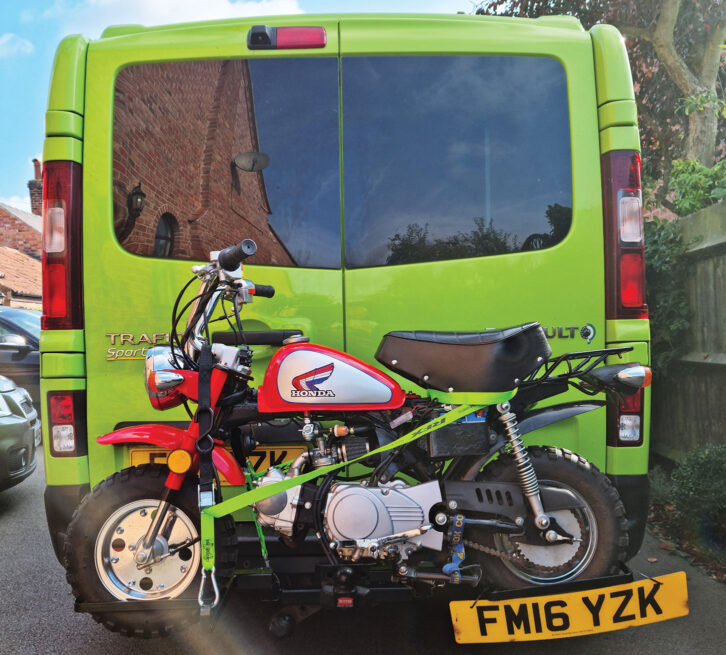
the vehicle’s maximum noseweight
Before installing anything on your motorhome’s towbar, it’s always worth visiting a local weighbridge to see what your vehicle actually weighs. If your vehicle is overweight (and in my opinion most are these days, or very close to maximum) you can either thin down your touring kit, or move it to a different place if just one axle is overladen. Equally, a box trailer can be a very effective way to decant extra weight into the towing allowance, rather than eating up the motorhome’s payload.
My advice on how to reduce the weight of a motorhome could also be well worth a look if you’re worried about an overladen ‘van, too.
Types of trailer
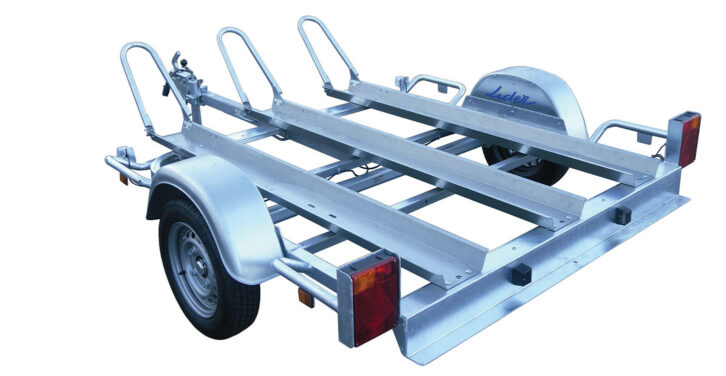
Trailers for toys come in all shapes and sizes, ranging from simple single-motorbike trailers that are lightweight and easy to store in a garage and cost under £1000 new, to full-on covered trailers for towing fancy racecars that can cost tens of thousands.
The key thing to think about with all these trailers is how much they weigh (with all their accessories such as ramps, lights and winches) and how easy the item is to load on them.
Most trailers for cars come with either removable loading ramps or a tilting bed that often has built-in ramps. Anything with removable loading ramps will take a lot longer to load than a tilt bed, and you often have to lug the ramps into position which can be quite a heavy job to do.
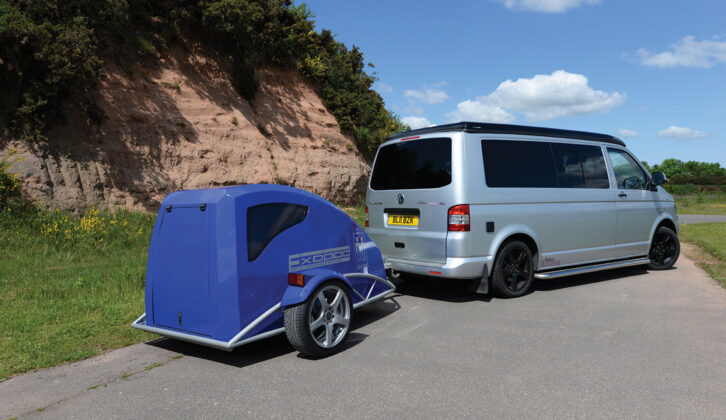
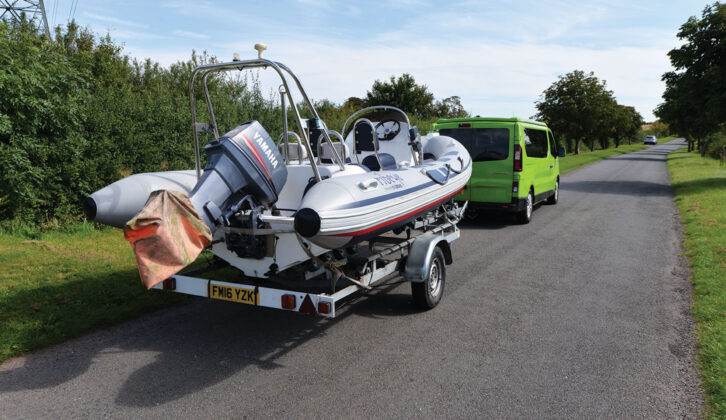
add some useful extra berths to any motorhome. They’re also much easier and lighter to tow than a caravan
Tilt beds are easier to use, but the tilting mechanism increases their weight, cost and complexity.
Covered vehicle trailers help keep the weather off the vehicles inside, but can make loading harder (as there’s a side section limiting your access to the tie-down points for the ratchet straps).
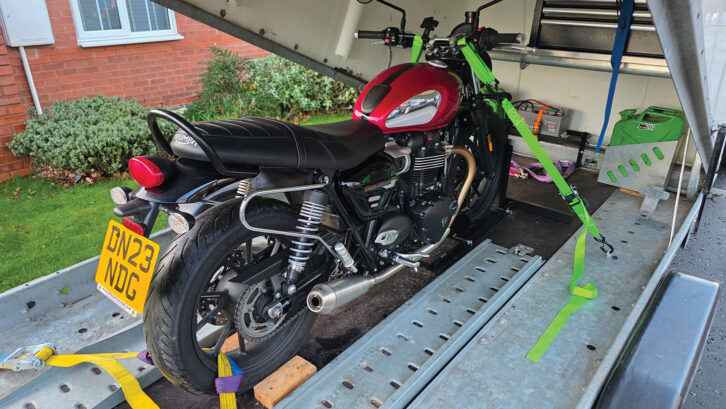
They’re also heavier to tow with and can make more of a dent in the tow vehicle’s fuel economy as they have a higher drag than an uncovered trailer.
Using a covered trailer for motorsport use not only protects your vehicle to a greater extend but also provides useful shelter if the British weather is doing its worst. We’ve also used them as party spaces for festivals, so they can be a really useful item to have!
Towing with A-frames
In the UK it is legal to tow with an A-frame and the combination of the car and the A-frame is considered to be a trailer. As such it must conform to trailer laws, specifically that the braking system must work independently of the motorhome.
The weight of the car is not relevant, because it is deemed to be a ‘braked trailer’ when bolted to an A-frame, the brakes must be active.
There are various methods to achieve independent braking on a car, ranging from mechanical systems that use a pull-wire on the brake pedal, to more sophisticated electronic units that measure deceleration or yaw and can then activate the car’s brakes.
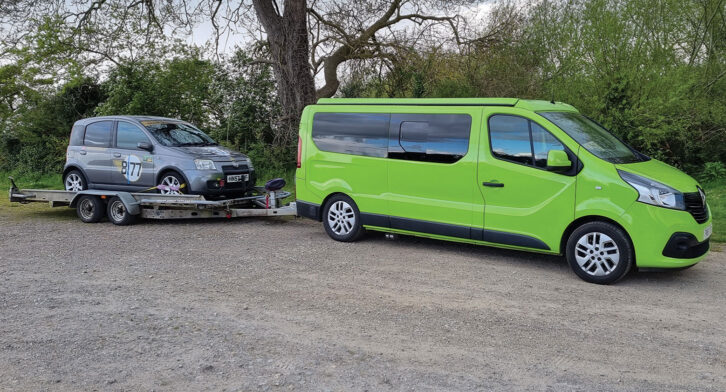
You also need to have a numberplate attached to the rear of the car that matches the numberplate of the tow vehicle and working rear tail-lights, indicators, numberplate lights and fog lamps. The easiest way to do this is to use a trailer board strapped to the rear of the car, but some people also modify the car’s tail-lights to activate independently.
If you’re thinking of heading overseas to Europe in a campervan, it’s worth knowing that towing laws vary and not all countries accept vehicles towed on an A-frame. We’ve heard tales of having to remove the car from the A-frame and drive it through the Mont Blanc tunnel separately – incurring an extra toll.
It’s worth noting – and we have also heard of on-the-spot fines issued in France and Spain. Germany doesn’t seem keen on them, either.
The issue for many European police forces is Type Approval. Vehicles are approved for EU use as either a car or a trailer, not a mixture of both. Concern over adding A-frame brackets to the front crash structure of a car and how that affects pedestrian safety and insurance are other issues.
So for these reasons we’d always recommend towing a car on a trailer if you plan to visit Europe.
Improving the security
Trailers are a real magnet for theft, so you should always use a Sold Secure or Thatcham-approved hitch lock and a wheel clamp on them, and make sure that they’re well insured. It’s also wise to add some smart tags to them – for example, Apple Air Tags or an Android compatible version.
It’s the same for bicycles left on a bike rack. Make sure that they’re secured with angle-grinder proof D-locks (Hiplok and Litelok make some good ones) and also pay attention to the type of towball that you have.
It’s no good using a fancy D-lock if a thief can simply unbolt the two big bolts on the towball itself. Many removable towballs can be locked in place, and many bike racks also have locking mechanisms to clamp them securely to the towball.
It’s also well worth covering bicycles and motorbikes with a cover on either bike racks or trailers, because crime statistics show that thieves are less likely to be attracted to a bike under a cover. Many covers can also be locked in place.
For high-value bicycles and ebikes, it’s best to store them inside the motorhome if you are going to be away from the vehicle for any lengthy period of time.
Worthwhile upgrades for tow vehicles
If you are thinking of doing a lot of towing, it makes sense to upgrade the rear suspension. While many manufacturers do offer uprated springs for the rear suspension, the problem is that this can make the suspension overly harsh when you’re not towing. A better solution is to opt for an air-suspension system on the rear.
The easiest systems to fit are the air-assistance units which usually replace the OE rubber spring assistor with a large airbag unit. These can either be pumped up manually to vary the amount of pressure inside them, or linked to a compressor (sometimes with an air tank so that the pump doesn’t need to activate as often) that varies the pressure in the air bag.
The higher the pressure, the firmer the airbag, which has a two-fold effect of raising the rear suspension to level the towed load and, when the vehicle isn’t towing, to reduce the amount of body roll in corners.
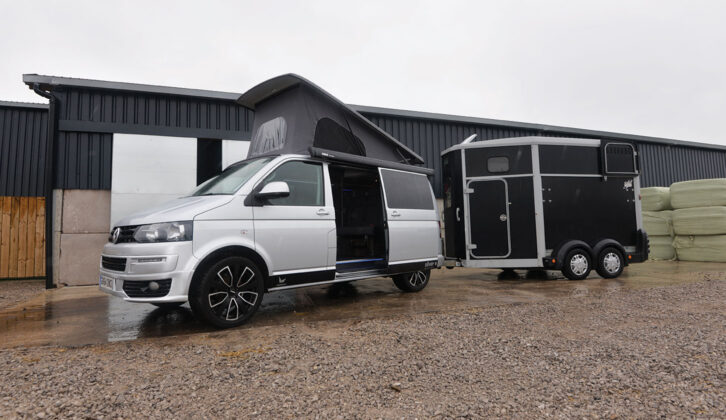
Prices for adding a rear air-assistance system start from a few hundred pounds for a basic set-up, to a few thousand pounds for a fully air-suspended system (which also replaces the original springs to give a full air ride set-up).
Even the most basic air assistance set-up gives a noticeable improvement in ride quality, stability and safety and is a modification that is well worth adding to any motorhome.
Another modification that can be helpful for diesel tow vehicles that are out of their manufacturers’ warranty is engine remapping.
These can increase the power and torque of a turbocharged diesel engine by around 20% and can make it a lot more relaxing to tow with. In some cases a remap can also help improve the fuel economy by allowing the vehicle to tow in a higher gear, resulting in a reduction in revs and improved fuel consumption on motorways and dual carriageways.
They do potentially come with downsides, however, so you’ll need to make your own decision on this.
For those of you who are looking at how to improve your fuel economy on the road, don’t miss my tips on minimising your motorhome fuel consumption.
Speed limits and insurance for trailers
You will also find that the motorhome speed limits you can drive at when towing a trailer will be subject to lower speed limits on certain roads in the UK (and in Europe – you should always check local limits).
On single carriageways the limit is 50mph, while it’s 60mph for dual carriageways and motorways. And don’t forget that while the limit in built-up areas in England, Scotland and Northern Ireland is 30mph, it’s 20mph for all vehicles (and towing vehicles) in Wales.
As for insurance, while it’s not essential for the trailer in the UK (but does offer peace of mind), it is mandatory for a visit to Europe and you may be asked for proof of it if you’re stopped by police. This change is a recent one that came about after Brexit.
Don’t miss what I had to say about motorhome tyre pressure either, as it can be more complicated to set it correctly than it is in a car.
Useful links
Where to find your nearest weighbridge
Future Publishing Limited, the publisher of Practical Motorhome, provides the information in this article in good faith and makes no representation as to its completeness or accuracy. Individuals carrying out the instructions do so at their own risk and must exercise their independent judgement in determining the appropriateness of the advice to their circumstances. Individuals should take appropriate safety precautions and be aware of the risk of electrocution when dealing with electrical products. To the fullest extent permitted by law, neither Future nor its employees or agents shall have any liability in connection with the use of this information. Double check any warranty is not affected before proceeding.
If you’ve enjoyed reading this, why not get the latest news, reviews and features delivered direct to your door or inbox every month. Take advantage of our brilliant Practical Motorhome magazine SUBSCRIBERS’ OFFER and SIGN UP TO OUR NEWSLETTER for regular weekly updates on all things motorhome related.